
The high value of measuring acoustic outcomes of completed work
RT60 calculation accuracy across a job archive
How closely predicted (calculated) reverberation time matches what was actually measured on site, drawn from jobs where both a calculated RT60 and a field measurement were undertaken. Client and site names have been removed for privacy.
An acoustic treatment calculation is a prediction made before the treatment is completed. Going back after the job is finished and measuring the real result is the only way to find out how well that prediction worked — it's easy to hand over a predicted RT60 and move on, but a prediction nobody ever checks against reality is just an assumption wearing a decimal point. Closing that loop on every job, even the ones that “obviously” turned out fine, is what separates a calculation method that's trusted because it's habitually right from one that's trusted because no one has looked. Measured-vs-calculated tracking like this does three things at once: it catches a systematic bias while it's still cheap to fix, rather than after a client has paid for a redesign; it builds an honest evidence base for how much margin to build into the next prediction; and it turns every completed job into a data point that makes the next calculation sharper instead of just another closed file. The numbers below are that check, run across jobs with both a calculation and a field measurement on record.
Summary
Jobs analyzed 19 — of ~40 candidate jobs found with any calculation + measured RT60 files
Mean variation (bias) +3.6% — measured − calculated, as % of calculated RT60, averaged across jobs — near zero means no systematic over/under-prediction
Calculated vs. measured RT60
Each point is one job's octave-band-averaged RT60. The dashed line is perfect agreement (calculated = measured).
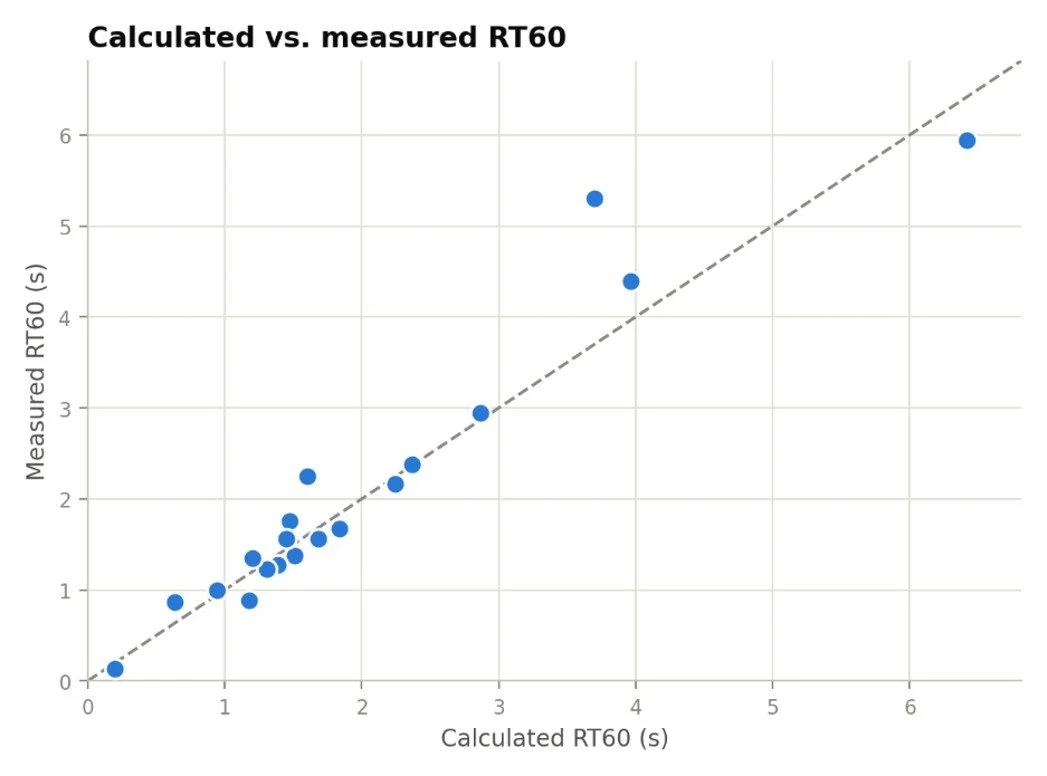
NB: Some rooms were measured before treatment, to calibrate the prediction. Some rooms did not have complete inventories of as constructed materials and estimates were made.